Orchestra of the Age of Enlightenment

About the OAE
Just over two decades ago, a group of inquisitive London musicians took a long hard look at that curious institution we call the Orchestra, and decided to start again from scratch. They began by throwing out the rulebook. Put a single conductor in charge? No way. Specialise in repertoire of a particular era? Too restricting. Perfect a work and then move on? Too lazy. The Orchestra of the Age of Enlightenment was born.
And as it began to get a foothold, the OAE made a promise to itself. It vowed to keep questioning, adapting and inventing as long as it lived. Residences at the Southbank Centre and Glyndebourne Festival Opera didn’t numb its experimentalist bent. A major record deal didn’t iron out its quirks. Instead, the OAE examined musical notes and instruments with ever more freedom and resolve.
That creative thirst remains unquenched. Informal night-time performances are redefining concert formats. Searching approaches to varied repertoires see the OAE involved in exceptional musical and non-musical collaborations. New generations of exploratory musicians are encouraged into its ranks. It enjoys a truly international reputation. New York and Amsterdam court it; Birmingham and Bristol cherish it.
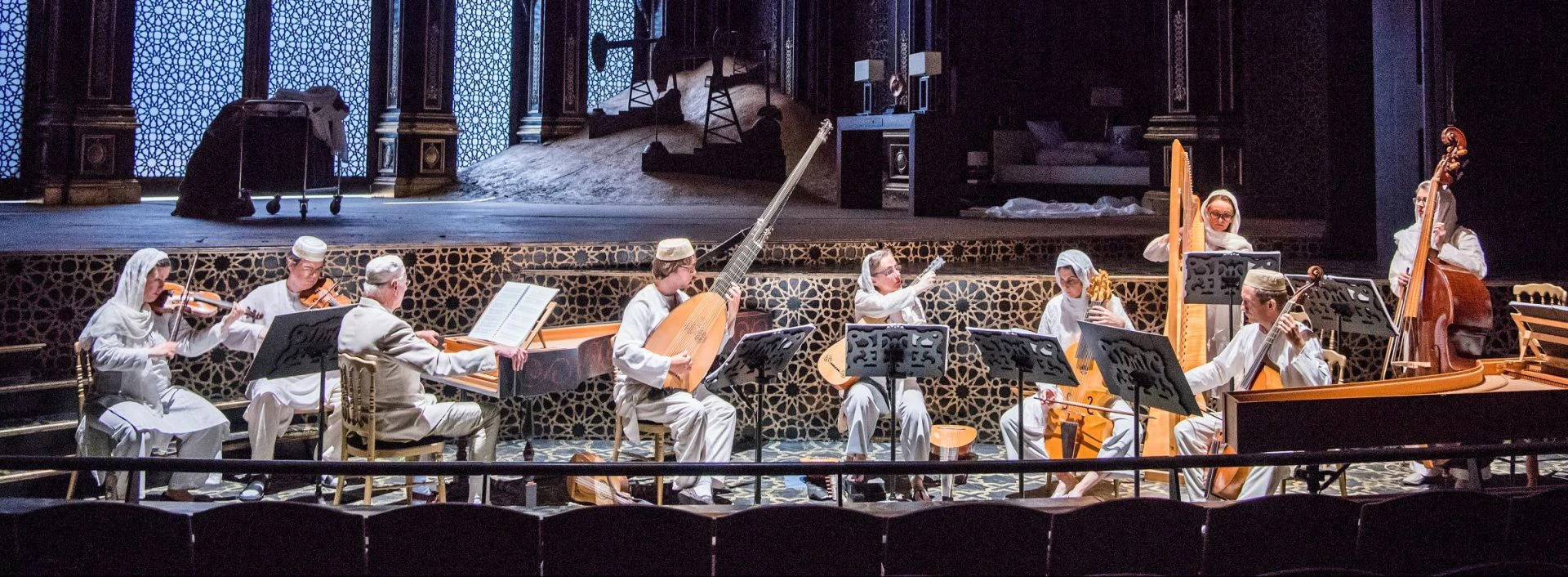
In its 24th season, the OAE is part of our musical furniture. It moved recently to beautiful new headquarters. It has even graced three legendary conductors – Rattle, Jurowski and Fischer – with a joint title. But don’t ever think the ensemble has lost sight of its founding vow. Not all orchestras are the same. And there’s nothing quite like this one.
The OAE at Glyndebourne
So integral is the Orchestra of the Age of Enlightenment to Glyndebourne – so much a part of the furniture – that it’s hard to believe it wasn’t always thus. This perfect marriage was triggered when Simon Rattle was invited by Glyndebourne to conduct Mozart’s Da Ponte operas there in 1988, whereupon he replied that he would only do so if the OAE was his orchestra; the happy collaboration duly began with Le nozze di Figaro. Since then the relationship has steadily deepened, with the OAE’s official Glyndebourne residency now celebrating its first ten years.
In this matter, Glyndebourne’s General Director David Pickard has been both poacher and gamekeeper: as chief executive of the OAE he negotiated the terms of this relationship, and after his move to Glyndebourne he oversaw its fruition. And the musical results have in his view been significant. While the OAE has been an obvious match for the Monteverdi, Purcell, and Handel of the last few years, what was not foreseen was the way the period-instrument OAE and the modern-instrument LPO would dovetail, and occasionally even reverse roles.
Thus in 2007 we had Così fan tutte played by the LPO on modern instruments, and La Cenerentola – whose production the LPO had previously premiered – played on period instruments by the OAE. "And this switching will sometimes continue,"says Pickard. "But only in works where period instruments can make a suitable difference, as with the early 19th century repertoire of Rossini and Donizetti. There’s still a sufficient difference between the way instruments sounded then, for period instruments now to bring out something fresh and unusual in the music. And it’s been nice to experiment in this way with German Romantic repertoire too, as with Weber’s Euryanthe."
This musical miscegenation doesn’t only apply to repertoire. Simon Rattle may have been the first ‘modern’ conductor to lead the OAE, but many others now do so too, while Vladimir Jurowski happily conducts both it and the LPO in rotation. It’s partly through the OAE’s benign influence that the ghettoization of ‘early music’ has evaporated, as has the old rivalry between early and modern ensembles. As OAE leader Margaret Faultless puts it, "The divide is now simply between good playing and bad playing". And the OAE plays astoundingly well. Simon Rattle once tried to put his finger on what made it so suitable for Mozart: "Period instruments have more colour, flavour, shape, and less weight than modern ones. They are more tangy, more piccante. We can play full out with the greatest passion, and still sound like Mozart."
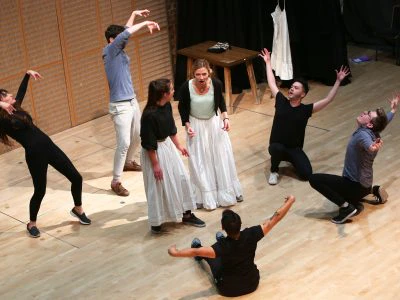
Having its summer home in Glyndebourne has helped the OAE both refine its playing and develop its ideas about how it will grapple with the challenges of a rapidly-changing music industry. And it’s collaborating with Glyndebourne’s education department in the outreach work essential for building an audience for the future. This year OAE players are working with Sussex schoolchildren and Trinity College students to compose new music based on Handel’s Rinaldo, which they will see at an afternoon performance on the opera house’s main stage.
Find out more on the Orchestra of the Age of Enlightenment Website
About the OAE © Andrew Mellor, 2009
The OAE at Glyndebourne © Michael Church, 2011
Photo: Eric Richmond/Harrison & Co